
How to Hang Peel & Stick Wallpaper
American Decals offers three carefully curated peel-and-stick wallpaper materials: FABRIC, PREMIUM, and CANVAS. Although they all have pressure-sensitive backings, their construction, texture, opacity, adhesive strength, seam requirements, and professional installation options are not identical.
Attention Installers: When Your Customer Wants Peel & Stick, Send Them Our Way. We’ve Got You.
Do not hesitate when your customer asks for peel-and-stick wallpaper. You do not have to choose between giving the customer the material they want and delivering a professional installation you can stand behind.
We understand why installers are cautious. Much of the inexpensive peel-and-stick material on the market is made from vinyl film that can stretch during installation and shrink afterward, exposing gaps along double-cut or butt seams.
Don’t Just Take Our Word for It—Try It Yourself
Are you a professional wallpaper installer who wants to evaluate our polyester peel-and-stick wallpaper before recommending it to a customer? We will send you two peel-and-stick test panels so you can handle the material, install it, reposition it, overlap it, double-cut it, and observe its dimensional stability for yourself.
Test our material before committing to it for a customer’s project. See how it installs, how it looks on the wall, and how the seams perform using your own professional methods. We are confident in our polyester wallpaper because we have worked with these materials for more than a decade—and we want you to feel equally confident before offering them to your clients.
Professional installers may contact American Decals to request two polyester peel-and-stick test panels.
Our polyester wallpaper does not shrink. Through more than a decade of printing, handling, installation, and long-term use, we have found that these materials remain dimensionally stable and do not produce the post-installation seam shrinkage associated with conventional vinyl films.
FABRIC and PREMIUM are polyester-based peel-and-stick wallcoverings. They can retain the supplied overlap or be professionally double-cut for a clean butt seam. They may also be installed with compatible clear wallpaper paste for a more secure, longer-term, or higher-humidity installation.
The result is the convenience your customer wants, the stability you need, and the soft, refined appearance of fabric on the wall. We carefully curate our wallpaper materials for print quality, handling, opacity, and installation performance. We do not use just any material simply because it has an adhesive backing.
Send your peel-and-stick customers to American Decals. We’ll help them select the right material—and help you approach the installation with confidence.
CANVAS Is the Exception
CANVAS Peel & Stick is our luxury textured vinyl wallcovering. It provides a substantial canvas finish and approximately 99% opacity, but it requires different seam and adhesive handling.
- FABRIC and PREMIUM: Dimensionally stable polyester wallcoverings that do not shrink. They may be overlapped, professionally double-cut, or installed with compatible clear wallpaper paste.
- CANVAS: Luxury textured vinyl wallcovering. Retain the supplied overlap. Do not double-cut it and do not install it with traditional wallpaper paste.
Know Your Peel & Stick Material
FABRIC Peel & Stick
- Our easiest peel-and-stick option for most DIY customers
- Flexible 6 mil polyester wallcovering
- Smooth matte-white finish with a soft textile appearance
- Approximately 80% opacity
- Best over white or very light-colored walls, especially with pale wallpaper designs
- Removable and repositionable during installation
- May retain the supplied overlap or be professionally double-cut
- May be installed with compatible clear wallpaper paste for a longer-term or higher-humidity installation
PREMIUM Peel & Stick
- Professional-grade GF234, 7 mil polyester wallcovering
- Smooth matte finish with a refined textile appearance
- Approximately 96% opacity
- Recommended for light wallpaper designs, colored walls, and projects requiring stronger coverage
- Removable and repositionable during installation
- May retain the supplied overlap or be professionally double-cut
- May be installed with compatible clear wallpaper paste for a longer-term or higher-humidity installation
CANVAS Peel & Stick
- Approximately 6 mil luxury textured vinyl wallcovering
- Decorative canvas texture with a substantial, elevated finish
- Approximately 99% opacity
- Excellent coverage over darker wall colors
- Strong pressure-sensitive adhesive
- Install with the supplied overlap intact
- Do not double-cut
- Do not install with traditional wallpaper paste
For a complete comparison, visit our Wallpaper Materials and Installation Guide or our How to Choose the Right Wallpaper Material guide.
Choose the Correct Installation Method
Standard Peel-and-Stick Installation
FABRIC, PREMIUM, and CANVAS may be installed using their existing pressure-sensitive adhesive on a compatible, clean, smooth, properly prepared wall.
Roman E-Z Hang Peel & Stick Helper may be sprayed onto the wall to provide slip, simplify pattern alignment, and improve surface contact. It is strongly recommended for standard peel-and-stick installations, particularly on large walls or designs requiring precise pattern alignment.
Longer-Term Professional Installation
FABRIC and PREMIUM may be installed with compatible clear wallpaper paste for a longer-term professional application. This method provides additional slip and bond strength while allowing installers to use familiar professional wallcovering techniques.
Do not use traditional wallpaper paste with CANVAS Peel & Stick.
Supplemental adhesive or wallpaper paste may change removability and the eventual removal process. Test the selected wallpaper material, adhesive, primer, and painted surface together before proceeding. Follow the adhesive manufacturer’s application instructions.
Bathrooms With Showers
For a bathroom with a shower, use a securely pasted installation. Choose CLASSIC, SELECT, or GRASSCLOTH Traditional wallpaper, or have FABRIC or PREMIUM polyester wallpaper professionally installed using compatible clear wallpaper paste.
Do not rely exclusively on a removable pressure-sensitive adhesive in a room that experiences regular shower steam and changing humidity.
CANVAS is not recommended for a bathroom with a shower. It is vinyl and must not be installed using traditional wallpaper paste.
Never install wallpaper inside a shower enclosure or in an area receiving direct water. Use an effective exhaust fan during showers and until excess humidity has cleared.
Roman E-Z Hang Peel & Stick Helper
Roman E-Z Hang is not traditional wallpaper paste. It is a spray-on installation aid that provides slip, allowing peel-and-stick wallpaper to float into position while the pattern is aligned. It also helps improve surface contact and reduces the need to repeatedly peel the panel away from the wall.
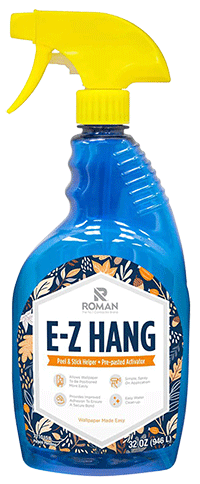
Roman E-Z Hang Key Features
- Provides slip so peel-and-stick wallpaper can be moved into position more easily
- Simplifies panel alignment and pattern matching
- Reduces the need to repeatedly peel and reapply a panel
- Helps improve adhesion and surface contact
- Sprays directly onto the prepared wall
- Cleans up with water
- One bottle covers approximately 60 square feet, or roughly five to six standard wallpaper panels
- Zero VOC as calculated under EPA Method 24
Roman E-Z Hang is strongly recommended for standard peel-and-stick installations using FABRIC, PREMIUM, or CANVAS.
We have tested Roman E-Z Hang with our peel-and-stick wallpaper and found that it makes positioning and pattern alignment easier while helping improve surface contact. It is available through Home Depot, Amazon, and wallpaper-supply retailers.
Before You Begin
Inspect the wallpaper and wall before beginning. Confirm that you received the correct design, material, panel quantity, and panel height. Installation confirms acceptance of the wallpaper, so contact us before hanging anything if a panel appears damaged, incorrectly printed, or out of sequence.
Tools You May Need
- Level or laser level
- Measuring tape
- Pencil
- Plastic wallpaper smoother or felt-edged squeegee
- Clean microfiber cloths
- Sharp utility knife with new blades
- Metal straightedge or trim guide
- Step ladder
- Roman E-Z Hang Peel & Stick Helper
- Compatible clear wallpaper paste when using the pasted-installation method with FABRIC or PREMIUM
- A second person for taller panels
Step 1: Inspect and Prepare the Wall
Peel-and-stick wallpaper performs best on a clean, dry, smooth, structurally sound, and properly painted interior wall. Repair holes, cracks, peeling paint, and prominent imperfections before installation.
New paint must cure for at least six weeks before wallpaper installation. Some low-VOC, zero-VOC, washable, scrubbable, stain-resistant, and specialty paints may require additional curing time or adhesion testing. Paint can feel dry while it is still curing and releasing gases that interfere with pressure-sensitive adhesives.
Do not install over loose paint, chalking paint, unprimed drywall repairs, damp walls, silicone residue, cleaning-product residue, or walls with an unresolved moisture problem.

Enhanced-Adhesion Cleaning Method
First, test the cleaning solution in an inconspicuous area. Clean the wall with a mixture of one part water and three parts isopropyl alcohol using clean, lint-free microfiber cloths. Replace each cloth as it collects residue so contamination is removed rather than redistributed.
Do not saturate or aggressively scrub the painted surface. Allow the wall to dry completely for at least 15 minutes. Do not use household cleaners, soap, degreasers, ammonia-based products, or products containing silicone because they may leave residue that interferes with adhesion.
Test Before Installing the Full Wall
Apply a sample or small test piece using the same installation method planned for the complete wall. Check it after 15 minutes, again after 24 hours, and, when possible, after 72 hours. Confirm that the edges remain secure and that the paint does not lift during repositioning or removal.
If the sample lifts, curls, or fails to develop a secure bond, stop and correct the wall condition before installing the complete order.
When planning to use Roman E-Z Hang or compatible clear wallpaper paste, perform the test using that same installation method. A dry adhesion test does not represent the performance of a paste-assisted installation.
The Day Before Installation
- Remove the wallpaper from its shipping package and unroll every panel.
- Do not discard the instructions or order documents.
- Identify the panel numbers printed on the back.
- Lay the panels flat on a clean, dry surface in the room where they will be installed.
- Arrange them in hanging order and confirm that the pattern flows correctly from one panel to the next.
- Allow the panels to rest flat for at least 24 hours so they can relax after shipping and acclimate to the room.
- Make sure all tools and supplies are ready before beginning.
You might need four hands for taller panels, so unless you are some kind of Hindu god, please remember to con a friend or loved one into helping.
Step 2: Plan and Arrange the Panels
Plan your design first. Or don’t. Each wallpaper panel should have a number printed on the back, but if we processed your wallpaper on “Margarita Friday,” please double-check anyway. Arrange the panels in numerical order and confirm that the pattern matches before removing any backing paper.
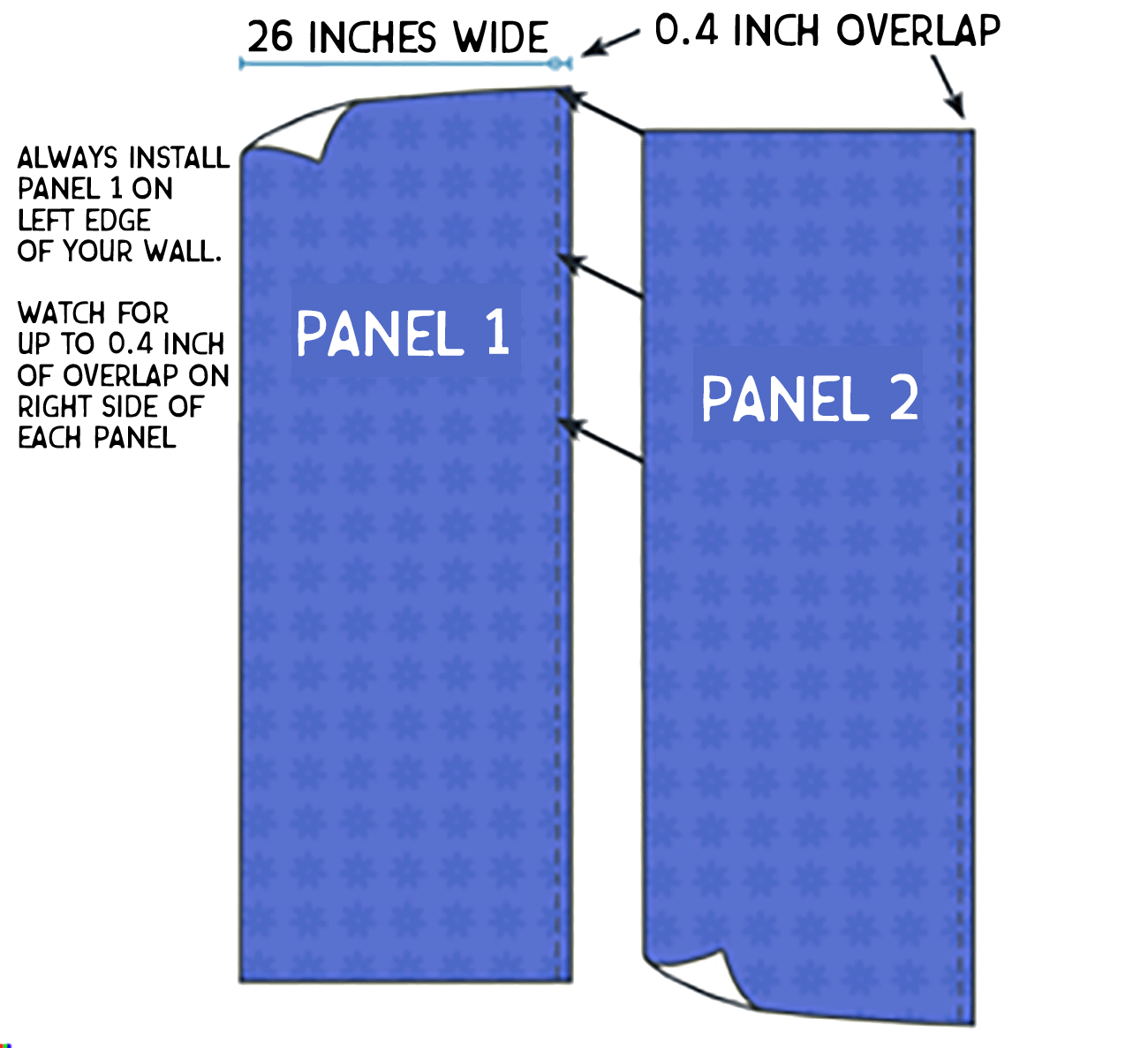
Measure the total combined width of the panels and compare it with the wall. Begin with Panel 1 on the left side of the installation area and proceed from left to right unless your order includes different instructions.
Allow approximately 1/2 to 1 inch of excess wallpaper above the ceiling line. This provides trimming allowance when the ceiling, floor, or adjoining wall is not perfectly square.
Step 3: Establish a Straight Starting Line
Do not assume the corner of the room is perfectly straight. Measure approximately one panel width from the starting corner and use a level or laser level to create a straight vertical guide.
The first panel controls the alignment of every panel that follows. Take your time with this step.
Step 4: Install the First Panel
For FABRIC, PREMIUM, or CANVAS: If using Roman E-Z Hang, spray it evenly onto the section where the first panel will be installed. Work in manageable sections and do not allow it to dry before applying the wallpaper.
If FABRIC or PREMIUM is being professionally installed with compatible clear wallpaper paste, follow the adhesive manufacturer’s application, open-time, and cleanup instructions. Do not use traditional wallpaper paste with CANVAS.
- Confirm that you have Panel 1 and that the top of the design is oriented correctly.
- Peel approximately 12 to 24 inches of release liner away from the top of the panel.
- Do not remove the entire release liner at once.
- Position the top with approximately 1/2 to 1 inch extending above the ceiling line.
- Align the panel with the vertical guide.
- Press the exposed adhesive lightly against the wall.
- Continue removing the liner gradually while smoothing the wallpaper downward.
- Work from the center toward the outside edges using overlapping strokes.
- Avoid pulling, stretching, or placing excessive tension on the wallpaper.
When Roman E-Z Hang is used, the panel can be gently floated or slid into its final position while the wall remains wet. Remove excess liquid with a clean cloth as you work.
Step 5: Install the Remaining Panels
Apply the selected installation aid, when used, to the next section of wall. Begin the next panel at the ceiling and align its printed design with the preceding panel.
Every panel includes approximately 0.4 inches of overlap. Place the new panel over the edge of the previous panel until the pattern aligns correctly. Do not trim the overlap before placing and matching the panels.
Continue removing the release liner gradually while smoothing from the center outward. Repeat from left to right until all numbered panels are installed.
Important: Do not place the panel edges directly beside one another without accounting for the supplied overlap. Discarding the overlap and creating an unplanned butt seam may cause the printed pattern to align incorrectly.
Step 6: Choose the Correct Seam Method
Overlap Seam for All Three Materials
The supplied approximately 0.4-inch overlap provides the most forgiving installation method. It preserves pattern alignment and helps prevent visible gaps. The overlap may remain on FABRIC, PREMIUM, and CANVAS.
On white or very light wallpaper, the doubled material at the overlap can appear slightly denser than the surrounding single layer. Darker, saturated, or detailed designs generally disguise overlaps more effectively.
Professional Double-Cut Seam for FABRIC and PREMIUM
Experienced wallpaper installers may double-cut the overlapped seam on our two polyester materials. Their polyester construction is dimensionally stable and does not shrink after installation.
A smooth, properly prepared wall produces the best result. Wall texture can interfere with clean edge contact and make the completed seam more noticeable.
- Align the design using the supplied overlap.
- Place a professional seam-cutting strip behind the overlap to protect the wall.
- Use a new, sharp blade and straightedge to cut through both layers.
- Remove the narrow waste strip from the upper panel.
- Lift the adjoining edge carefully and remove the waste strip underneath.
- Bring the two cut edges together without stretching either panel.
- Gently smooth or roll the completed seam.
Double-cutting is a professional technique. Cutting directly into drywall or the painted surface can damage the wall and contribute to future seam failure.
CANVAS Seam Requirement
Keep the supplied overlap on CANVAS Peel & Stick. CANVAS is a textured vinyl wallcovering and requires different seam handling from the polyester materials.
- Do not double-cut CANVAS.
- Do not butt the panel edges together.
- Do not install CANVAS with traditional wallpaper paste.
- Use its existing pressure-sensitive adhesive, with Roman E-Z Hang if desired.
Step 7: Trim the Installation
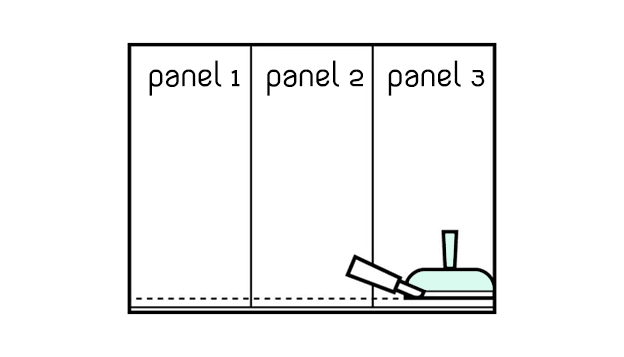
Use a sharp utility knife and metal straightedge to trim excess wallpaper along the ceiling, floor, and outside edges.
- Use a new blade at the beginning of the trimming process.
- Replace the blade after every few cuts.
- Use light, controlled pressure.
- Avoid cutting deeply into the drywall or painted surface.
- Support the wallpaper with a straightedge while trimming.
After trimming, inspect every edge, corner, and seam. Apply firm, even pressure to ensure complete contact with the wall. Wipe away remaining Roman E-Z Hang with a clean, damp cloth.
After Installation
- Allow the wallpaper and wall to dry naturally at room temperature.
- Maintain good airflow without directing strong fans or heat at the wall.
- Avoid excessive humidity and major temperature changes during the first 24 to 48 hours.
- Do not scrub or wash the wallpaper immediately after installation.
- Check edges, corners, and seams after the wall has dried.
- If an edge begins lifting, correct it promptly instead of allowing the separation to spread.
When Should I Choose Peel & Stick Wallpaper?
- Renter-friendly projects: FABRIC, PREMIUM, and CANVAS may be practical where traditional pasted wallpaper is not permitted, subject to wall compatibility and removal testing.
- Temporary installations: Suitable for events, seasonal spaces, and rooms redesigned more frequently.
- Accent walls and smaller areas: Convenient for feature walls, alcoves, entryways, and decorative installations.
- DIY installation: FABRIC is our easiest and most forgiving peel-and-stick option for most DIY customers.
- Greater opacity: Choose PREMIUM for approximately 96% opacity or CANVAS for approximately 99% opacity.
- Professional installation: FABRIC and PREMIUM can be overlapped, professionally double-cut, or installed with compatible clear wallpaper paste.
- Luxury texture: Choose CANVAS when you want a substantial embossed texture and excellent coverage while retaining the supplied overlap.
When May Peel & Stick Not Be the Best Choice?
- Heavily textured walls: Uneven surfaces reduce adhesive contact, may remain visible beneath the wallpaper, and can make seams more noticeable.
- Uncured or unstable paint: Wait at least six weeks after painting and confirm that the paint is securely bonded.
- Bathrooms with showers: Use a securely pasted installation. Choose CLASSIC, SELECT, or GRASSCLOTH Traditional, or have FABRIC or PREMIUM professionally installed using compatible clear wallpaper paste. Do not use CANVAS.
- Persistent humidity or direct water: Do not install wallpaper where there is an unresolved moisture problem or direct water exposure.
- Contaminated or resistant surfaces: Washable, scrubbable, antimicrobial, stain-resistant, or silicone-containing paint may interfere with adhesion.
For additional help, review our Wallpaper Materials Guide, How to Choose the Right Wallpaper Material, How to Measure Your Wall, and Wallpaper and Wall Decal Adhesion Troubleshooting Guide.
Questions before installation? Please contact American Decals before hanging the wallpaper. We would much rather help you evaluate the wall, material, and installation method before the project begins.